How STRC on Margin Works
Banks take your money, lend it out at a much higher rate, and pay you almost nothing. Most people never leave, so they never have to. This guide is about flipping that around. It works, I run it in my own account, and it can also go badly wrong. So we're doing both halves.
 15:21
The video version. Heads up, some rates have moved since I filmed it. The numbers below are current.
The idea in one line
Borrow at a low rate. Get paid at a higher rate. Keep the difference.
The borrowing is a margin loan from your broker, against stocks you already own. No credit check, no income verification, and it takes minutes. That's exactly why it can be dangerous. The thing paying the higher rate is STRC.
What STRC actually is
STRC is a preferred stock from Strategy, the company that used to be called MicroStrategy and holds a huge amount of Bitcoin. It trades on Nasdaq under the ticker STRC, so you can buy it at a normal broker.
- Price
- Built to trade around $100 a share. It closed at $99.35 on September 30, 2026.
- Yield
- 12.00% a year right now. Strategy sets the rate and has said it'll keep recommending 12% until STRC trades steadily near $100.
- Paid
- Twice a month, on the 15th and the last day of the month. That's $0.50 a share each time. Strategy has asked shareholders to approve daily payments, with a vote on October 28, 2026.
- Cumulative
- If Strategy skips a payment, it doesn't disappear. It goes on a tab that keeps compounding at the dividend rate until it's paid.
- Callable
- Strategy can buy it back at $101 a share.
Michael Saylor's way of putting it: MSTR is the rocket ship, Bitcoin is the fighter jet, and STRC is the passenger jet. You give up the upside for a smoother ride.
The math, worked out
I'm not using my own numbers here. Here's a made-up but realistic example. Say you have a $100,000 portfolio of broad index funds, and you borrow $25,000 against it on Robinhood to buy STRC.
| Per year | Per month | |
|---|---|---|
| Buy 250 shares of STRC at about $100 | $25,000 | |
| Dividends at 12% | +$3,000 | +$250 |
| Margin interest at 5.25% | −$1,312.50 | −$109.38 |
| What you keep | $1,687.50 | $140.63 |
That's about a 6.75% return on money you didn't have to put in. Scale it up and the monthly number gets interesting. So does the risk.
It depends on your broker
Nothing about this is Robinhood specific. STRC trades on Nasdaq and margin loans are a standard product. What changes is the rate, and it changes everything.
| Broker | Rate on a $25K loan | What you keep per year |
|---|---|---|
| Robinhood | 5.25% | $1,687.50 |
| Interactive Brokers (Pro) | 5.38% | $1,655.00 |
| Fidelity | 11.575% | $106.25 |
| Charles Schwab | 11.575% | $106.25 |
Same position, same dividend. At Fidelity or Schwab the spread is basically gone, and you're taking all the risk for about $9 a month. Rates as of late September 2026, from each broker's margin page. They move with interest rates and with how much you borrow.
One email when there's something real, never more. Not financial advice.
Where the margin call is
This is the part most videos skip. A margin call is when your broker decides your own money in the account is too thin compared to what you owe, and makes you add cash or sells your stuff for you. Usually at the worst possible time.
On Robinhood, STRC has a 70% maintenance requirement. That means for every $100 of STRC you hold, $70 has to be your own money, not borrowed. For the index funds in this example I'm assuming 25%, which is typical, but check yours.
The $25,000 example. Even if STRC fell to its 2026 low, the index funds would have to drop about 74% before you'd get a margin call. That's a lot of room.
The greedy version. Same $100,000 portfolio, but you borrow $100,000 and buy 1,000 shares. Now you'd make about $6,950 a year after interest. But you'd get a margin call the moment STRC fell below about $83. In June 2026 it closed as low as $74.57.
That's the whole lesson. The income scales with how much you borrow, and so does how close you are to getting wiped out. Stay far away from the margin call line.
How Strategy pays 12%
This is the right question to ask. Strategy's software business brought in $122.4 million last quarter, so call it about half a billion a year. That's revenue, not profit. What it owes every year in preferred dividends and interest is about $1.6 billion.
So most of the money doesn't come from the business. It comes from three places:
Selling new shares. Strategy sells new stock into the market and uses the cash.
Selling Bitcoin. For years the story was that Strategy never sells Bitcoin. That changed in 2026. Between late May and early August it sold about 6,948 Bitcoin for about $432 million, partly to pay dividends and partly to buy back STRC.
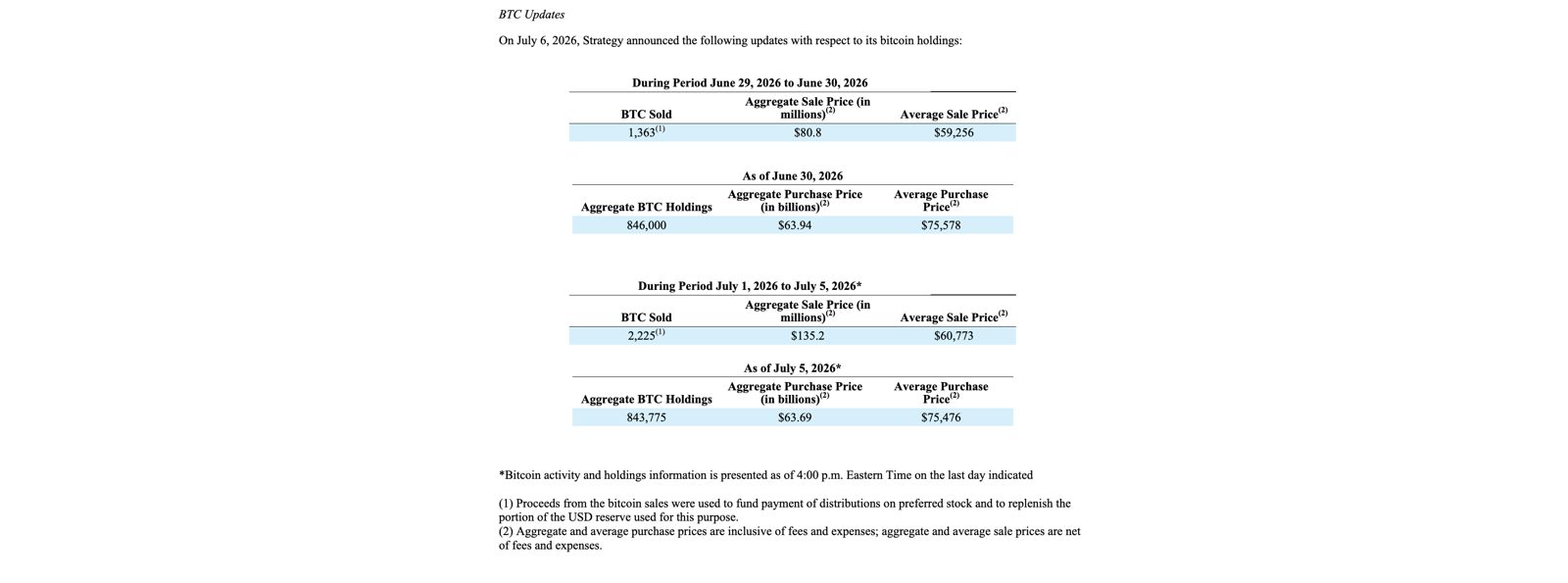
A cash reserve. Strategy keeps a US dollar reserve just for these payments. As of September 27, 2026 it was $5.02 billion, which covers about three years of payments. Back in May it had dropped to $0.90 billion, which is the moment to remember.
The whole machine depends on one thing. The market has to value Strategy at more than the Bitcoin it holds. That ratio is called mNAV. Above 1, Strategy can keep selling shares at a premium and everything works. Below 1, the machine starts to break.
The risks
1. The dividend can stop. Strategy can pause payments at any time. The skipped money stays on the tab and compounds until it's paid, but the cash stops showing up. Meanwhile you're still paying your margin interest.
2. The rate can be cut. Not suddenly, though. Each cut is capped at a quarter point plus any drop in short-term rates, it can't go below one-month SOFR (about 3.9% right now), and Strategy can't cut while it owes skipped dividends.
3. The $100 peg can break. It already did. On June 26, 2026 STRC traded as low as $71.25. Strategy has spent a lot buying STRC back to push it toward $100, and it's clearly motivated to, but there's no law or rule that says it has to stay there. If you need to sell during a drop, you take the loss.
4. Margin calls. Everything above, but borrowed. A drop that's annoying in a cash account can force a sale in a margin account.
5. Concentration. STRC rides on Strategy, and Strategy rides on Bitcoin. If your other holdings are crypto or crypto-linked stocks, they can all fall at the same time.
6. Taxes. So far Strategy has said its preferred dividends count as a return of capital, which lowers your cost basis instead of being taxed as income now. That can change. Talk to a tax professional.
This is not a savings account. The money you put in isn't guaranteed to be the money you take out.
What happened when it dropped
I bought STRC near $100, on margin. Then it fell hard in June. Not gonna lie, it was scary. I was down big, and I had that feeling of, did I just make a stupid decision on this unproven thing. Someone I trust told me to trim the position.
I didn't. I'd read the filings and watched a lot of Saylor and Phong Le, the CEO, and I decided it looked more like a temporary headwind than a structural break. It came back to around $98 by September. That worked out. It also might not have, and if I'd been borrowed closer to the line, I wouldn't have gotten to choose.
Who this is for
Better fit: bigger, steady portfolios. Money you won't need for a while. Someone who'll actually read how STRC works and keep borrowing well away from the margin call line.
Bad fit: anyone who might need the money soon, because you could be forced to sell low. And anyone whose portfolio is already volatile, like penny stocks, crypto-linked stocks, or cyclical stuff.
Even if it fits, don't put everything in one place. Spreading your passive income across a few sources probably means a lower total return, but it's safer, and it's the better long term play. I plan to run this for maybe one to two years, re-evaluate every 12 months, and use some of the income to pay the loan down.
How to set it up
- Look up your broker's margin rate for the amount you'd borrow. If it's not well under 12%, stop here.
- Turn on margin, and find the maintenance requirement for STRC and for what you already own.
- Decide how much to borrow, then work out where the margin call would hit, like the examples above. Make sure STRC's 2026 low wouldn't get you there.
- Buy STRC. Ticker S-T-R-C on Nasdaq.
- Turn dividend reinvestment off for STRC, so the payments go toward your margin balance instead of buying more.
- Watch Strategy's cash reserve, not the share price. If it starts shrinking toward a few months of coverage, that's your signal.
If you take one thing from this, take this. Look up what you can borrow at. Then ask whether there's something safe and stable that pays more than that. STRC is one answer. It isn't the only one, and it isn't risk free.
Sources
- Strategy STRC page: price, rate, reserve, obligations (checked Oct 1, 2026)
- STRC certificate of designations: rate cut limits, cumulative dividends, $101 call
- Strategy 8-K, September 1, 2026: 12% rate and dividend policy
- Strategy 8-K, September 28, 2026: USD Reserve of $5.02 billion
- Strategy 10-Q filings: Q2 2026 revenue of $122.4 million, return of capital treatment
- Margin rates: Robinhood, Interactive Brokers, Fidelity, Schwab